When we think of urban infrastructure and smart city management, our minds usually jump to high-tech sensors, 5G networks, or solar-powered amenities. However, one of the biggest and most expensive challenges local authorities face today is far less glamorous: maintaining the structural integrity of our streetlights against everyday weathering, road salt, and—surprisingly—dog urine.
Constant exposure to dog urine causes significant accelerated corrosion at the base of lamp posts. For local authorities across the UK, this translates to logistical headaches, safety hazards, and millions of pounds drained every year on maintenance, repairs, and structural replacements.
Enter PeeTGuard—a simple, highly effective protective collar designed to safeguard lamp posts from this exact damage, fundamentally shifting how we manage and maintain our streetscapes. But just how big is the opportunity for PeeTGuard in the UK? Let’s look at the numbers.
The Scale of the UK Opportunity
There are an estimated 5.6 million streetlights across the United Kingdom. Currently, when a column requires corrosion protection or structural maintenance at its base, the go-to industry solution typically relies on bitumen treatments.
While functional, traditional bitumen applications are labor-intensive, carbon-heavy, and incredibly expensive. By replacing these outdated, high-emission treatments with PeeTGuard’s protective collars, the UK has an opportunity to modernise its approach to infrastructure preservation at an unprecedented scale.
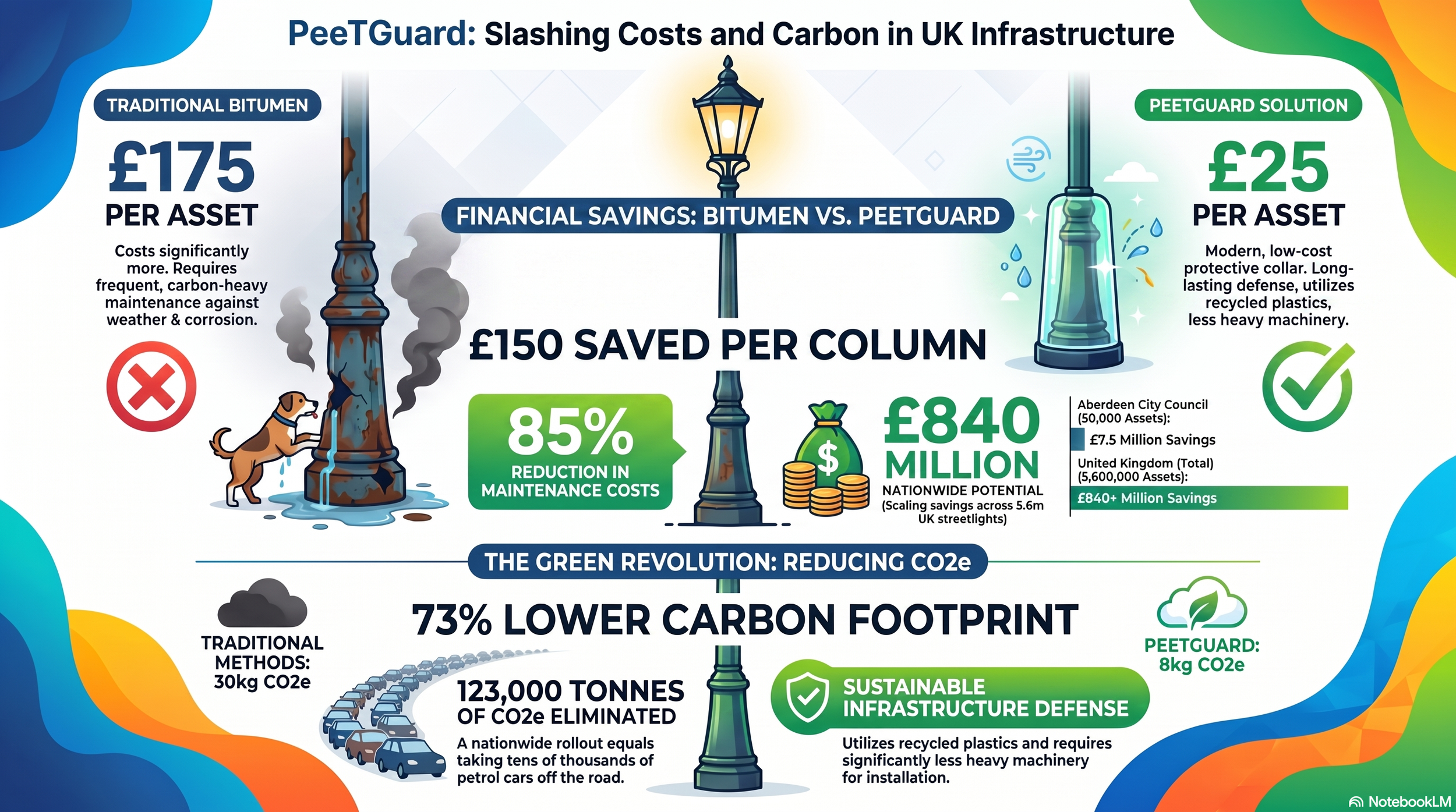
Infrastructure Efficiency Comparison
Unlocking Massive Revenue Savings for Local Authorities
Local councils are under immense pressure to balance budgets, and infrastructure maintenance is a significant line item. Based on recent comparative data, the financial savings unlocked by PeeTGuard are staggering:
Traditional Bitumen Treatment: Costs around £175 per asset (factoring in materials, labor, and traffic management).
PeeTGuard Solution: Costs roughly £25 per asset.
The Savings: An incredible £150 saved per column.
To put this into perspective, if a council like Aberdeen City—which manages roughly 50,000 assets—were to transition from traditional bitumen treatments to PeeTGuard, it could unlock a potential £7.5 million in revenue savings.
If we scale this £150-per-asset saving across the UK’s 5.6 million streetlights, local authorities are sitting on a potential nationwide cost reduction of over £840 million. Those are vital funds that can be redirected into community enhancements, social care, or further green energy initiatives.
A Massive Leap for Carbon Reduction (CO2e)
Financial savings are only half the story. As local authorities race to meet net-zero targets and reduce their carbon footprints, minimizing the emissions tied to structural maintenance is critical.
Traditional Maintenance Footprint: Standard treatments require heavy plant machinery, transport, and carbon-intensive materials like bitumen, generating around 30 kg of CO2e per asset.
The PeeTGuard Footprint: Thanks to lighter materials (often utilizing recycled plastics) and drastically reduced installation requirements, PeeTGuard emits just ~8 kg of CO2e per asset.
This represents a carbon saving of 22 kg of CO2e per lamp post.
If implemented nationwide, PeeTGuard has the potential to eliminate over 123,000 tonnes of CO2e from the UK’s infrastructure supply chain. That is the equivalent of taking tens of thousands of petrol cars off the road for an entire year—just by changing how we protect the bases of our streetlights.
A Smarter Future for Urban Landscapes
The future of our urban landscapes relies on integrating sustainable, long-term practices that don't drain public resources. PeeTGuard embodies the essence of smarter city management by merging functionality with environmental responsibility.
By tackling a localized but universal issue—corrosion from dog urination and weather—PeeTGuard is offering UK local authorities a golden opportunity to slash maintenance budgets, protect their assets, and make a massive dent in their carbon emissions. It's proof that sometimes, the most effective innovations aren't the most complex; they are the ones that solve everyday problems brilliantly.
